
PALLET TRACKING SYSTEM (P2S)
USING RFID

INTRODUCTION
A Pallet Tracking System using RFID is a powerful solution designed to provide real-time visibility and accurate tracking of pallets throughout the supply chain, from manufacturing and warehousing to distribution and sometimes even retail. This system significantly automates and improves inventory management, logistics, and operational efficiency compared to manual methods or even barcode systems.
HOW A PALLET TRACKING SYSTEM WITH RFID WORKS
1. RFID Pallet Tagging
Each pallet is affixed with a durable RFID tag (typically passive UHF) that stores a unique identifier (EPC). This ID is associated in a database with the pallet's contents, origin, destination, and other relevant data.
2. RFID Infrastructure (Readers & Antennas)
Fixed readers are installed at key choke points (dock doors, production lines, conveyor belts). Handheld readers are used for spot checks, and forklift-mounted readers can provide automatic inventory updates as pallets are moved.
3. Data Capture & Transmission
When a tagged pallet passes a reader, its unique ID is automatically read. The data (tag ID, reader ID, timestamp) is instantly transmitted to a central system like a WMS or ERP.
4. Software & Analytics
The central software processes the data, updating the real-time location and status of each pallet. It provides insights into movement patterns, inventory levels, and potential bottlenecks, and can generate alerts for unauthorized movements.
Key Benefits
- Real-time Inventory Accuracy: Virtually eliminates manual counting errors.
- Reduced Labor Costs: Automates tracking, reducing manual scanning and data entry.
- Improved Throughput: Speeds up receiving, put-away, and shipping processes.
- Enhanced Visibility: Complete end-to-end visibility of pallet movement.
- Faster Search & Location: Quickly locate misplaced pallets.
- Reduced Shrinkage/Loss: Helps prevent loss, theft, and misplacement.
- Optimized Space Utilization: Better planning of warehouse space.
- Seamless Integration: Can integrate with existing WMS and ERP systems.
Key Components
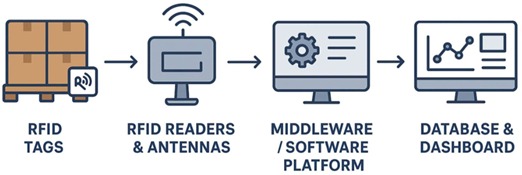
- RFID Tags: Passive or Active tags attached to pallets storing ID, contents, and shipment details.
- RFID Readers & Antennas: Fixed readers at gates and zones, plus handheld readers for manual checks.
- Middleware / Software Platform: Captures data and integrates with WMS/ERP for inventory updates.
- Database & Dashboard: Centralized storage of movement records with real-time dashboards for monitoring and analytics.
SYSTEM ARCHITECTURE & APPLICATIONS
Application Areas
- Warehouses & Distribution Centres
- Retail Chains
- Manufacturing Plants
- Cold Storage & FMCG
- Logistics Providers
Challenges
- Cost: Initial investment can be higher than barcode systems.
- Interference: Metals and liquids can cause read accuracy issues.
- Tag Placement: Optimal placement is crucial for reliable reads.
Ready to optimize your pallet management?
Open Requirement Form